Community stories
HPP is rare enough that most people who have it have never met anyone else who does. These pages are where that changes.
My name is Elisa, and this is my hypophosphatasia story.
A childhood fracture, decades of unanswered questions, and a blood-test result whose significance went unrecognised for years.
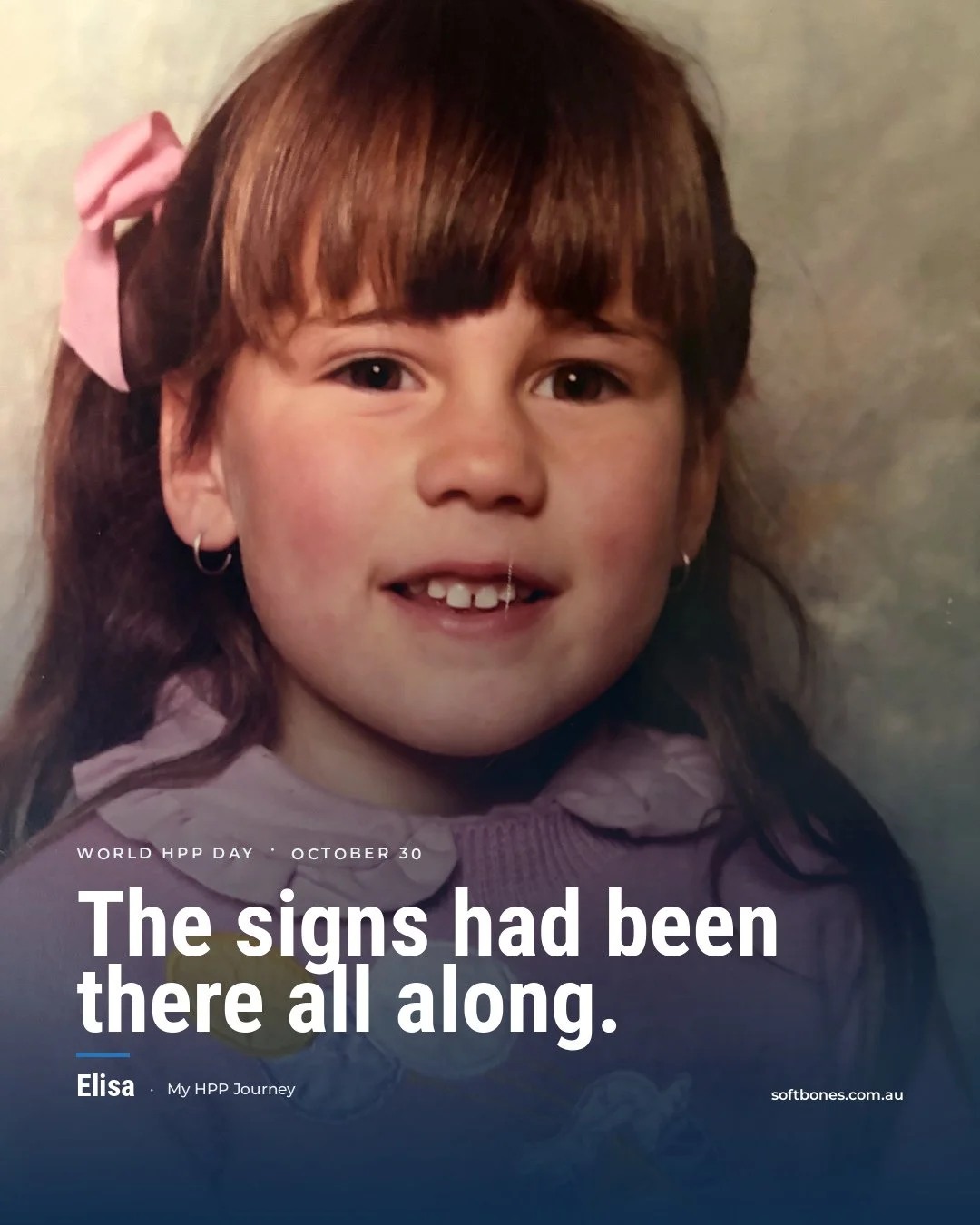
The signs had been there all along.
Elisa · Manager, Soft Bones Australia · Living with hypophosphatasia
This photograph was taken shortly after my first arm fracture. At the time, it looked like a simple childhood accident — the kind of thing that happens to any child. Like most families, we had no reason to think it was the opening page of a much longer story.
As I grew, there were signs. Symptoms that seemed unrelated to one another, and often went unexplained. Years passed. I kept having health problems, and still no one joined the dots.
It would take decades before I was finally diagnosed with hypophosphatasia — HPP — a rare inherited metabolic condition that affects how the body develops and maintains healthy bones and teeth.
The diagnosis brought two things at once. Relief, because I finally had an explanation for so much of what I had lived with. And frustration, because the signs had been there the whole time.
The most important of those signs was persistently low alkaline phosphatase — ALP. It is a hallmark of HPP. But as happens to many people living with a rare disease, the significance of that result went unrecognised for years. Looking back, I can see that much of what I struggled with, as a child and as an adult, was connected by a condition that stayed hidden in plain sight.
Being diagnosed changed how I understood my health, and what I expect from my future. It let me find others living with HPP. It taught me about the condition I had carried for so long without knowing its name. And it set me on a different path — advocating for awareness.
Today I want to help other people and families avoid the journey I had. No one should spend decades searching for answers. That is why I share my story: to raise awareness of hypophosphatasia, to encourage healthcare professionals to recognise what a persistently low ALP result can mean, and to help others find support, understanding, and a much earlier diagnosis.
The little girl in this photograph had no idea what lay ahead of her. If I could speak to her now, I would tell her that the answers would come — and that one day her journey would help other people find theirs.
Your story could be here. More community stories are on the way. If you would like to share yours, please give your story.
How it works
Deliberately simple, and at whatever pace suits you.
You get in touch
A short message through the contact form is enough. You do not need to have anything written.
We have a conversation
By phone, video or email, whichever you prefer. If it is easier, we can ask questions and write it up from your answers.
You review the draft
Nothing is published until you have read it and said yes. Change anything you want changed.
You choose how it appears
Name or anonymous, photo or none, full story or a short extract.
It stays yours
Ask us to take it down or amend it at any point, and we will.
Prompts, if a blank page is hard
What were the first signs something was wrong? How long did it take to get an answer, and what happened in between? What did you get told before HPP was mentioned? What changed after the diagnosis, for better or worse? What do you wish a doctor had asked you sooner? What would you say to someone who has just been diagnosed?
Connecting with other Australians
One of the hardest parts of a rare condition is the isolation. Most Australians with HPP have never spoken to another person who has it.
Building a national peer network is one of our founding priorities. We are not going to pretend it exists yet, but it will only exist if people put their hand up, so if the idea appeals, tell us.
What we're working towards
- One-to-one peer connection, matching people with someone at a similar stage or with a similar experience
- Online meet-ups for patients, and separately for parents and carers
- A private community space where people can ask questions without an audience
- A national gathering, once there are enough of us to fill a room
In the meantime
International HPP communities are well established and welcoming, and several already include Australian members. If you would like to connect with others now rather than wait, these are worth looking at:
- Soft Bones (United States), which runs an online community with country-specific spaces, including one for Australia
- Soft Bones Canada, which runs a community and expert Q&A
- GSNV support group directory, covering Australian rare disease groups more broadly
Bear in mind that treatment and funding information on overseas sites reflects those countries' health systems, not Australia's.
Reviewed August 2026.